Reverse Age Calculator
Enter an age (Years, Months, Days) and a reference date to calculate the exact Date of Birth.
Calculated Date of Birth:
What is a Reverse Age Calculator?
A Reverse Age Calculator is a specialized mathematical utility that functions effectively as a Date of Birth Calculator. While a standard Age Calculator requires you to input your birthdate to find out how old you are, this tool flips the script. By inputting a known age (broken down into years, months, and days) alongside a specific chronological reference date, the tool calculates the exact day, month, and year an individual was born. For more specialized chronological tools covering different scenarios, be sure to browse our full suite of Age Calculators.
How It Works
The logic behind this tool relies on calendar subtraction. Much like a Past Age Calculator, the algorithm takes your chosen reference date and counts backward chronologically. It subtracts the exact number of days, then the months, and finally the years you have input. Our JavaScript engine seamlessly adjusts for the varying lengths of months (28, 30, or 31 days) and automatically detects leap years to ensure flawless accuracy.
Formula
While calculating age chronologically is straightforward, the reverse formula is mathematically structured to handle calendar anomalies. The core formula behind the calculation is:
Date of Birth = Reference Date - (Known Years + Known Months + Known Days)
To execute this manually, one must first subtract the days, borrow from the previous month if necessary, then subtract the months, and finally the years. Using an automated tool eliminates human error entirely.
How to Use
Using this system is highly intuitive and requires only a few clicks:
- Input the Age: Type the known age into the Years, Months, and Days fields. (If you don't know the exact months or days, you can leave them blank).
- Select the Reference Date: By default, this is set to today's date. If the person was that specific age on a historical date, change the calendar to match.
- Calculate: Click the primary action button. The tool will instantly reveal the exact date of birth, the day of the week they were born, and their corresponding Zodiac sign.
Past Age Calculation
This feature is a favorite among genealogists, historians, and legal professionals. Often, historical documents (like 19th-century census records, ship manifests, or gravestones) will list an individual's exact age at the time the record was created, but omit their birthdate. By utilizing a Past Age Calculation approach, researchers can pinpoint the exact origin date of their ancestors without tedious manual calendar counting. Furthermore, if you are attempting to verify strict upper or lower age limit criteria for public sector examinations based on past cutoff dates, you may also find our Government Age Calculator highly useful.
Future Age Calculation
You can also use this tool with a Future Age Calculator mindset. Let’s say you are planning a retirement fund or a trust that matures when a beneficiary turns 65 on a specific future date (e.g., "They will turn 65 on January 1, 2050"). You can enter those parameters into the tool to instantly calculate the original birth date required for the paperwork. Similarly, HR professionals who track long-term corporate milestones or total employment duration frequently benefit from using a dedicated Service Age Calculator.
By Date of Birth
Most traditional web tools are designed to calculate metrics strictly By Date of Birth. This reverse logic tool exists specifically to bridge the informational gap when that primary piece of data is missing, lost to time, or obscured in records.
Age Difference
If you are attempting to establish an exact timeline between two individuals, you might first use an Age Difference Calculator to find the exact gap in years, months, and days. Once you know that precise gap, you can input those values into the reverse calculator—using the younger person's birthdate as the reference date—to accurately deduce the older person's date of birth.
Reference Table: Age Calculation Examples
Here is a quick reference guide showing how different inputs affect the final calculation:
| Known Age Input | Reference Date | Calculated Date of Birth | Common Use Case |
|---|---|---|---|
| 30 Yrs, 0 Mos, 0 Days | January 1, 2024 | January 1, 1994 | General milestone calculation. |
| 64 Yrs, 3 Mos, 10 Days | June 12, 1890 | March 2, 1826 | Genealogy and gravestone tracing. |
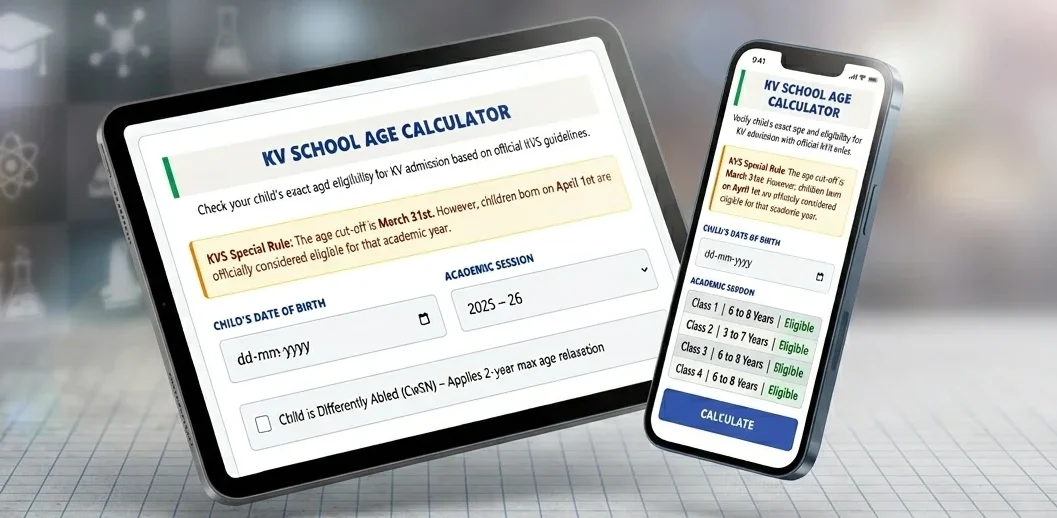
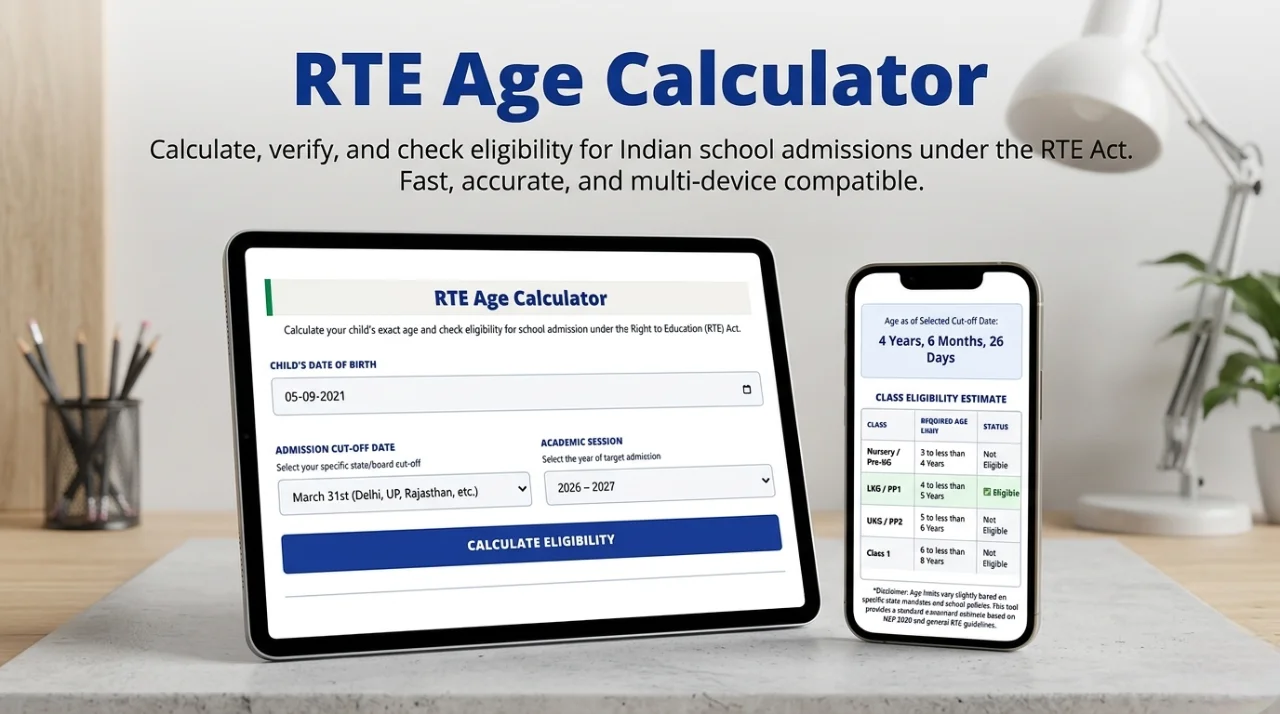
| 5 Yrs, 6 Mos, 0 Days | April 1, 2025 | October 1, 2019 | Verifying academic cutoffs. (For specific rules like Kendriya Vidyalaya admissions, try our School Age Calculator India). |
| 18 Yrs, 6 Mos, 0 Days | December 31, 2025 | June 30, 2007 | Future legal age determination. |
Frequently Asked Questions (FAQs)
1. Does the tool account for leap years?
Yes, absolutely. Our underlying JavaScript algorithm utilizes standard chronological Gregorian calendar mathematics. This means if your reverse calculation crosses February during a leap year (such as 2024, 2020, or 2016), the 29th day is automatically factored into the math, ensuring a 100% mathematically accurate result.
2. What if I only know their age in years, but not months or days?
You can still use the calculator! Simply enter the years into the first input box and leave the months and days empty (or enter them as zero). The tool will output an estimated Date of Birth, assuming the reference date was their exact birthday.
3. Is a Reverse Age Calculator the same as a Date of Birth Calculator?
Functionally, yes. While a Date of Birth Calculator can sometimes mean a tool that tells you fun facts about the day you were born, this specific reverse calculator is the most literal interpretation: it calculates your actual exact date of birth using your current (or past) chronological age data.
4. Can I use this to find the exact day of the week someone was born?
Yes! One of the built-in features of our tool is that once the Date of Birth is reverse-calculated, it automatically determines and displays the specific day of the week (Monday, Tuesday, etc.) that the individual was born on based on historical calendar data.
5. How accurate is the past age calculation for historical dates?
The calculator is perfectly accurate for any date following the adoption of the Gregorian calendar (which occurred in 1582 for many European countries, and 1752 for the British Empire and its colonies). For genealogical dates prior to the mid-1700s, researchers should manually verify dates due to the historical shift of missing days during the calendar changeover.