ACADEMIC BACKLOG CALCULATOR
Track active backlogs, dead backlogs, and clearance rates for placements
- Enter the Total Subjects you have attempted so far across all semesters.
- Enter your Total Failed Subjects (historical backlogs).
- Enter how many of those backlogs you have Cleared (passed in a re-attempt).
Active vs. Dead: “Active” backlogs are exams you currently need to pass. “Dead” backlogs are failed exams you have already cleared. Top-tier companies usually demand 0 Active Backlogs to sit for interviews.
Academic Status Report
What is an Academic Backlog?
In higher education systems, a backlog occurs when a student fails to secure the minimum passing marks required in a specific subject during the regular end-semester examination. When you receive an ‘F’ grade, that subject officially becomes a backlog. You are then required to re-register and clear it in a subsequent supplementary or “arrear” examination to complete your degree.
Using a reliable backlog calculator helps university and engineering students accurately track their failed subjects, monitor their clearance rates, and maintain a clear picture of their placement eligibility.
Use our academic backlog calculator to track failed subjects and arrears. Easy, fast, and free tool for students to manage academic progress.
Active Backlogs vs. Dead Backlogs
When reviewing your academic history for job placements or higher education admissions, universities and corporate HR departments divide backlogs into two distinct categories. Understanding this difference is vital for your career planning.
| Type of Backlog | Definition | Impact on Placements |
|---|---|---|
| Active Backlog (Pending) | A subject you have failed and have not yet passed. | Severe. Most top-tier companies will strictly forbid you from sitting for interviews. |
| Dead Backlog (Cleared) | A subject you previously failed, but have since passed in a supplementary re-exam. | Moderate. Many companies accept 1-2 dead backlogs, provided your overall CGPA is high. |
How Does a Backlog Impact Your CGPA?
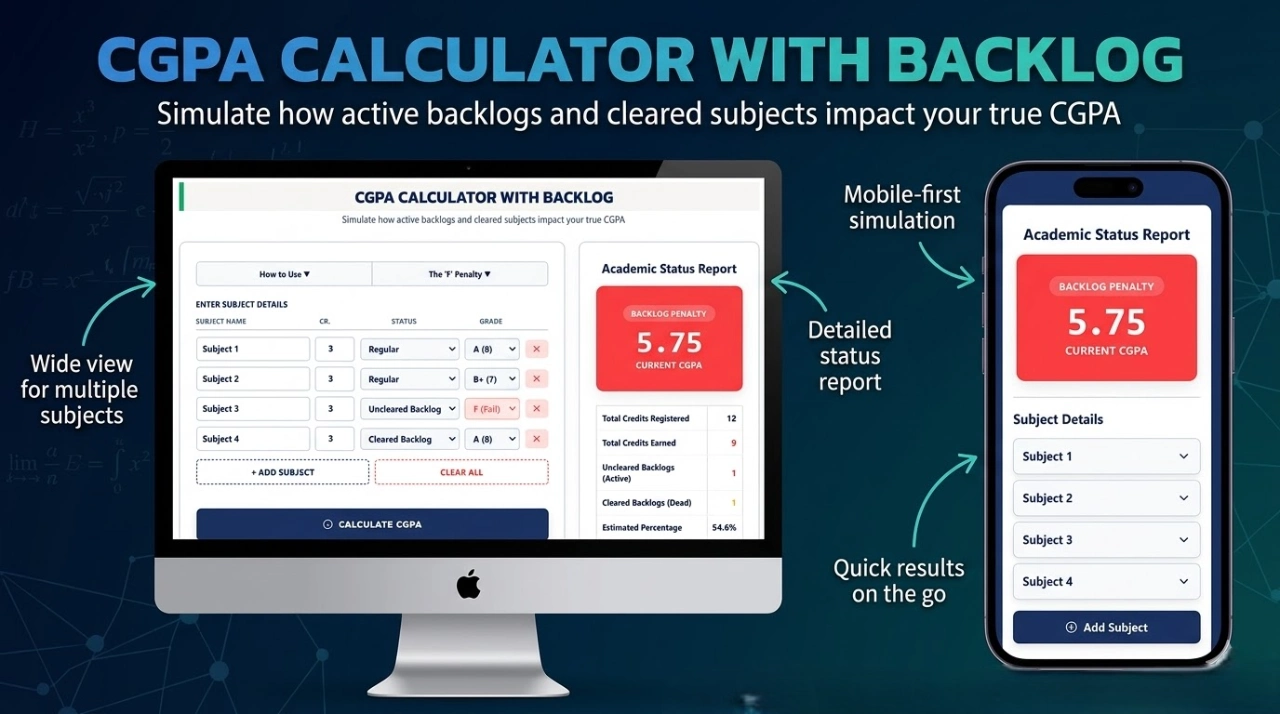
Failing a subject deals a massive mathematical blow to your Cumulative Grade Point Average (CGPA). This happens because of the formula used in standard credit-based grading systems:
- The Denominator Grows: Even if you fail, the credits assigned to that subject are added to your “Total Credits Attempted”.
- The Numerator Stays Zero: Because you failed, you earn exactly 0 Grade Points for that subject.
Dividing your total score by a larger number of credits without adding any new points severely drags down your average. Fortunately, once a backlog is cleared (becoming a dead backlog), the new passing grade points replace the 0, and your CGPA will significantly recover. You can simulate this exact scenario using a CGPA calculator.
Do Backlogs Affect MS / Master’s Applications Abroad?
Yes. International universities closely scrutinize academic transcripts. While a low number of cleared (dead) backlogs won’t automatically disqualify you, a high number of backlogs can raise red flags regarding your academic consistency. Admission committees look at your Backlog Certificate—an official document issued by your university stating exactly how many subjects you failed and the attempts it took to clear them. A high clearance rate combined with strong standardized test scores (GRE/GMAT) can help offset a poor backlog history.
Company Placement Criteria for Backlogs
If you are preparing for campus placements, your backlog history is just as important as your technical interview skills. Here is a general breakdown of how different tiers of companies handle backlogs:
- Tier 1 Companies (FAANG, Top Tech): Strict criteria. They demand 0 Active Backlogs and heavily prefer 0 Dead Backlogs (a pristine academic record).
- Tier 2 Companies (Major IT Services – TCS, Infosys, Wipro): Moderate criteria. They strictly require 0 Active Backlogs at the time of the interview, but generally allow up to 1 or 2 Dead Backlogs across your 4-year degree.
- Tier 3 / Startups: Flexible criteria. Many startups prioritize practical coding skills over university grades and may allow students to interview even with 1 Active Backlog, provided it is officially cleared before the onboarding date.
Site Sources
The logic and calculations provided in our backlog tracking tool are based on the standardized credit and grading frameworks implemented by leading educational authorities in India and abroad. For official grading guidelines, please refer to the following trustworthy sources:
- University Grants Commission (UGC) India: The primary regulatory body outlining the standard 10-point grading system and CBCS (Choice Based Credit System) used by major universities.
- All India Council for Technical Education (AICTE): The statutory body governing technical and engineering education standards, including examination and placement eligibility norms.
Frequently Asked Questions (FAQs)
Does an ‘F’ grade reduce my earned credits?
Yes. If you fail a 4-credit subject, those 4 credits are not added to your “Earned Credits” total. You must clear the subject to officially earn those credits and meet your university’s minimum graduation requirements.
Do dead backlogs show up on my final degree certificate?
Typically, no. Your final, consolidated degree certificate usually only displays your final CGPA and graduation class (e.g., First Class with Distinction). However, dead backlogs will be highly visible on the individual semester mark sheets where the failure and subsequent pass occurred.
What is a ‘Year Back’ or ‘Year Down’?
A “Year Back” occurs if you accumulate too many active backlogs (the specific threshold varies by university, often around 4 to 6 active backlogs in a single year). If you cross this limit, the university will prevent you from moving to the next academic year until you clear the pending subjects, effectively delaying your graduation by a full year.